Choosing a family boat: kids on board
Secure cockpit, netted lifelines, separate cabins, a swim platform you can watch: the concrete criteria for choosing a family boat with kids on board.
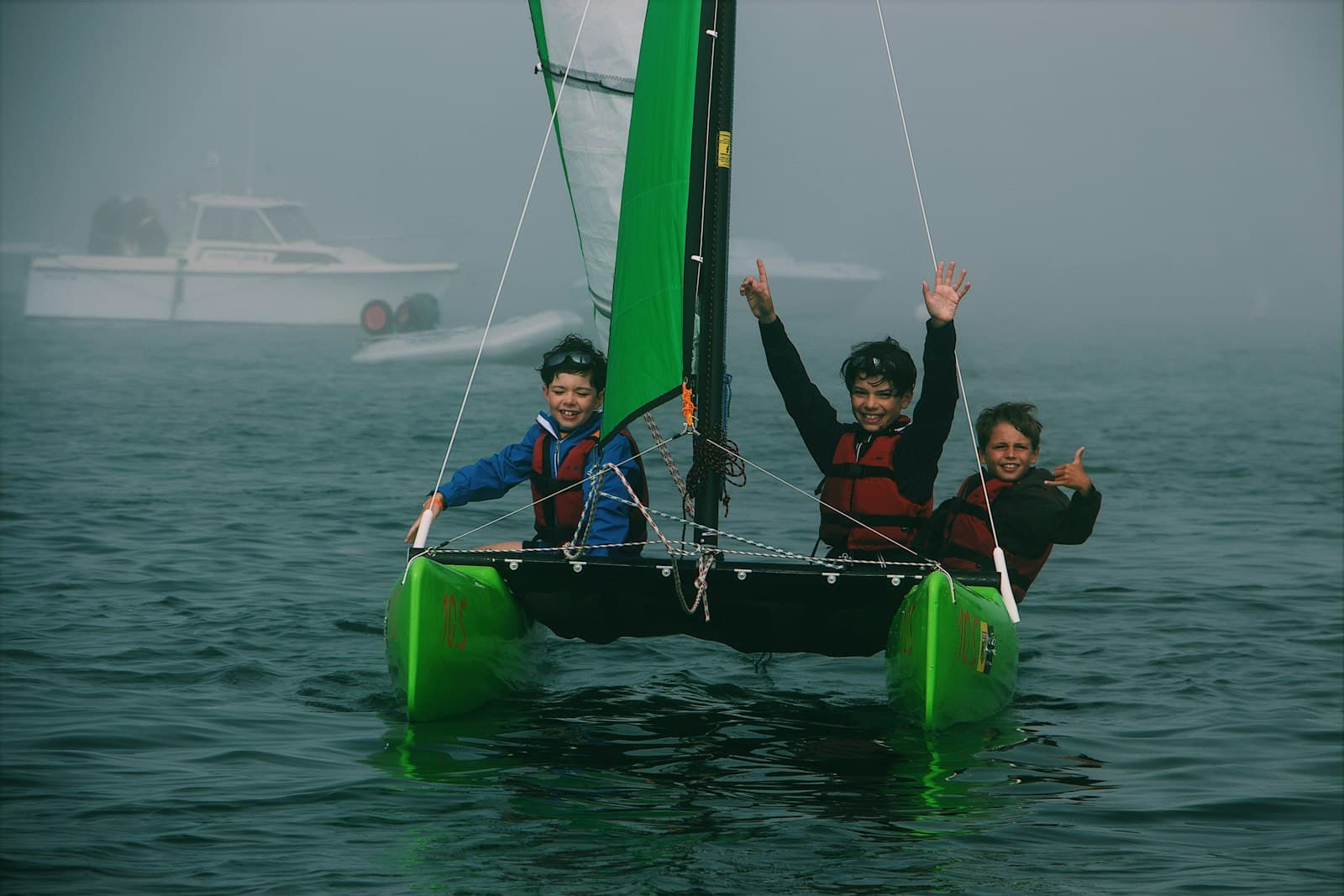
A good family boat can be recognised by four concrete criteria: a deep, secure cockpit; high lifelines doubled with safety netting; separate cabins that protect everyone's sleep; and a swim platform shielded from the propeller and visible from the cockpit. Everything else — brand, performance, prestige — comes second. With kids aboard, it is the layout that makes the holiday, not the spec sheet.
Passive safety first
The golden rule with children: a safe boat is one you cannot fall off, not one where adults catch falls. In practice:
- A deep cockpit with high coamings and a gate or closing rail on the transom side.
- Lifelines at least 60 cm high, doubled with netting along the full length — fitting costs a few hundred euros and changes everything.
- Wide, uncluttered side decks with continuous handrails, so everyone moves around on the flat.
- A windlass and lines led back to the cockpit, so the adult on watch never has to leave the children unattended.
Add active safety on top: lifejackets sized to each child's actual weight, worn from the moment they leave the saloon, and simple rules repeated at every departure.
Cabins and berths: the privacy that saves the holiday
For two nights aboard, everyone sleeps anywhere. For two weeks, everyone needs territory. Aim for a real cabin — or a dedicated berth — per child from age 6-8, and be wary of "berths as advertised": the eight berths of a 36-footer often include the converted saloon table, exhausting to live with daily. A parents' cabin away from the children's — forward on a monohull, in the opposite hull on a catamaran — protects the sleep of some and the privacy of others. Check berth heights too: a four-year-old in an upper berth without a lee cloth means one fall per night. Ventilation matters as much as the layout: an opening hatch per cabin keeps sleeping children comfortable on hot anchorage nights, and a dark, quiet forecabin buys parents a precious extra hour in the morning.
The swim platform, centre of gravity of the day
At anchor, 80% of a family's day happens between the cockpit and the water. The swim platform becomes critical infrastructure: wide enough to sit on, with a ladder that reaches deep below the surface — small children cannot haul themselves onto a rung 20 cm underwater —, a deck shower, and above all a direct line of sight from the cockpit for constant supervision. Watch propeller proximity: on some sports cruisers the platform sits directly above the drives. Engine off and key out from the first swimmer, no exceptions.
Monohull, catamaran or powerboat: which platform
The catamaran often stands out as the ultimate family platform: no heel, a trampoline doubling as a playroom, separate hulls for sleeping, and a cockpit on the same level as the saloon. Its cost — berth included — remains the main obstacle. A well-designed monohull works very well for a markedly lower budget; our monohull or catamaran comparison walks through the trade-off. On the power side, a cruiser with a large protected cockpit and an enclosed saloon reassures in mediocre weather and shortens the passages — children tolerate long hours at sea badly. In every case, a suitable programme (two to three hours under way at most, sheltered anchorages) matters more than the platform you pick.
The clever details that change everything
A few layout details make daily life: a fridge accessible without going below (teenage autonomy), a saloon with a view out for rainy days, closed stowage at child height, a full bimini — sun is the number-one hazard at sea for small children — and a stable, rigid-floor dinghy, because it becomes the anchorage school bus. Conversely, be wary of large sliding glass doors that cannot be locked, steep companionways, and cockpits open aft with no means of closing them off.
Where to start
Three steps before you look at a single model:
- Write down your real programme: how many weeks per year, which cruising area, and how old will the children be in three years? The method is set out in defining your cruising programme.
- Charter the type of boat you are considering first, for a week, with the children: nothing replaces the full-scale test.
- Then visit with a checklist: passive safety, real berths, swim platform, stowage — in that order.
The right family boat is not the prettiest on the dock: it is the one the children beg to come back to.
Frequently asked questions
From what age can you take a child on a boat?
From a few months old for short trips in calm weather, with a lifejacket sized to their weight and strict sun protection. Most families wait until age 2-3 for week-long cruises. Age matters less than the programme: short passages, sheltered anchorages, and one adult dedicated to supervision.
What family boat suits four people?
For two adults and two children, a 36-43 foot sailing yacht with three cabins, or a catamaran around 40 feet, strike the right balance of space, budget and ease of handling. On the power side, a 33-40 foot cruiser with two enclosed cabins and a large cockpit covers coastal use very well.
Is lifeline netting really essential?
With children under 8-10, yes. It costs a few hundred euros fitted, goes on in a few hours, and prevents a slide under the lifelines — the most common fall scenario. It replaces neither the lifejacket nor supervision, but it adds the layer of passive safety that lets children move around.
Reading is the easy part. Then you have to decide.
A boat purchase turns on what you cannot see: the real history, the state of the hull below the waterline, how much room there is to negotiate. We represent you — independent of any seller, paid by you alone.