France's canals: the great inland journey
The Midi, Burgundy and the Seine: 5,000 miles of waterways, licence-free hire boats, tolls, air draft and depth limits. Your guide to inland France.
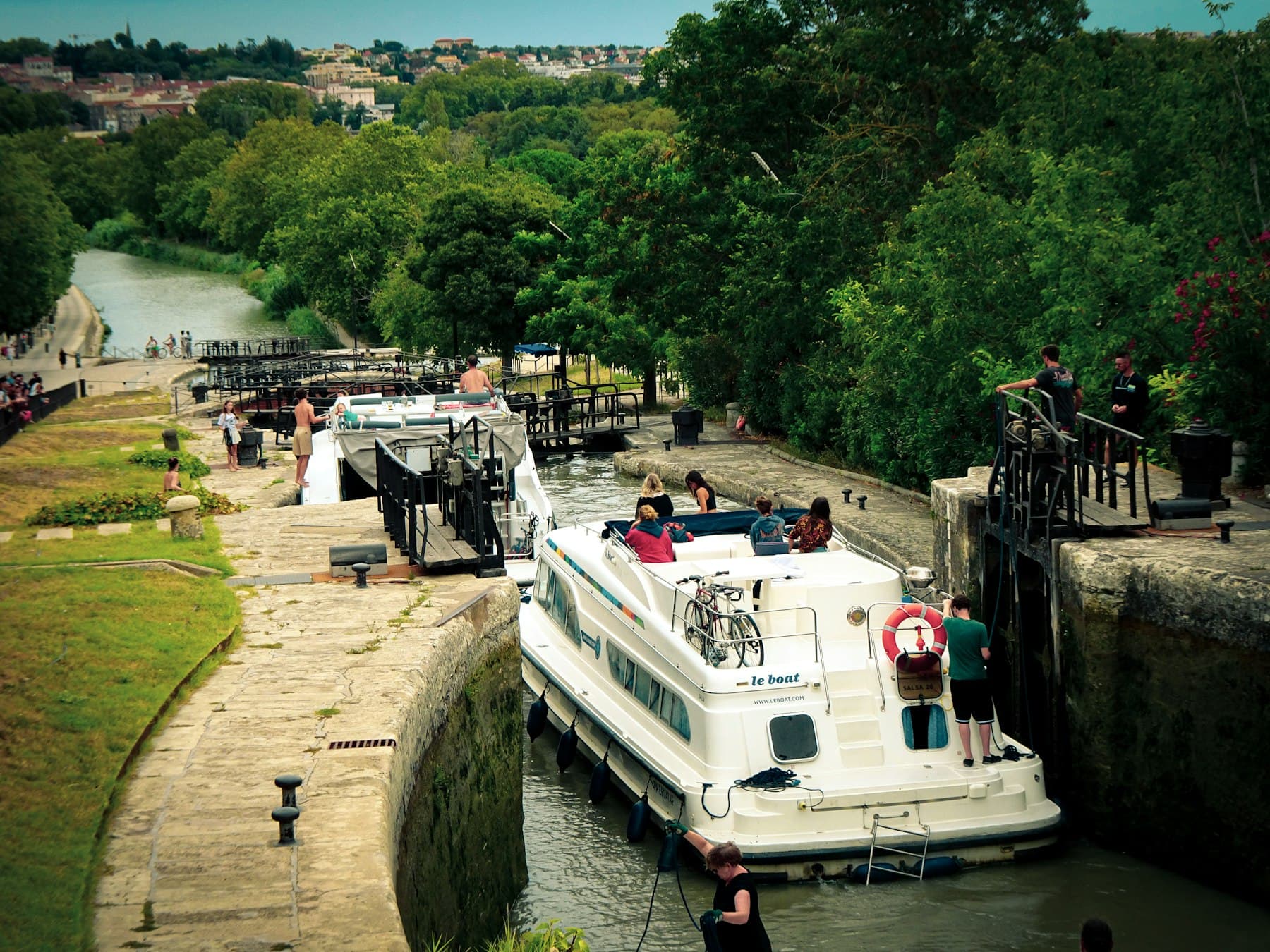
With roughly 8,500 kilometres — about 5,000 miles — of navigable canals and rivers, France has the largest inland waterway network in Western Europe: you can travel from the Channel to the Mediterranean without ever going to sea. There are two ways in: a licence-free hire boat, accessible after a short briefing, to test the life for a week; or your own boat with the VNF waterways toll, respecting the two numbers that decide everything — air draft and water depth.
The Midi, Burgundy, the Seine: three moods
The Canal du Midi, a Unesco site, remains the star: 240 kilometres under the plane trees between Toulouse and the Étang de Thau, oval seventeenth-century locks, and the Languedoc countryside within cycling reach of the towpath. The Burgundy network plays a different tune: quieter, more bucolic, with the Pouilly tunnel, the vineyards, and stretches where you meet more herons than boats. The Seine is inland boating at full scale: commercial convoys, 180-metre locks, and a transit of Paris on booked slots — magical, but demanding, with mandatory VHF and a boat able to hold 6-8 knots. Three schools, three levels of commitment — and beyond them, Alsace, Brittany and the Lot valley each offer their own quieter variation on the theme.
Air draft and depth: the two numbers that decide
The Freycinet-gauge network has 38.5 by 5.05 metre locks — ample for pleasure craft — but the real constraints are vertical. Air draft is often capped at 3.3 to 3.5 metres under the lowest bridges (the Canal du Midi is among the tightest), and the theoretical 1.8 metre depth translates in practice to 1.4 to 1.6 metres of usable water depending on the reach and silting. A sailing yacht can cross France with the mast lashed on deck, provided the keel draws less than about 1.5 metres; a low-profile trawler or Dutch steel cruiser fits almost everywhere. Check your route bridge by bridge before committing: there is no turning around in a narrow canal.
Licence-free hire boat or your own boat
Licence-free chartering is the great gateway to inland France: liveaboard boats up to 15 metres, speed limited to 8-10 km/h, with a mandatory one-hour briefing at departure — no qualification needed, whatever your nationality. Expect 1,500 to 3,500 euros a week depending on season and size, sleeping 4 to 8. With your own boat the rules change: for foreign-flagged visitors, the standard ticket is an ICC (International Certificate of Competence) with the CEVNI endorsement covering European inland waterway rules — check the exact requirements for your flag. The theory is manageable, and it opens up an immense playground including Belgium and the Netherlands.
The VNF toll and a season's budget
Cruising the network run by Voies Navigables de France is paid for through a toll sticker (the vignette), priced on the boat's area (length by beam) and duration: from tens of euros for a short-stay pass to a few hundred euros for an annual permit on a 12-metre boat — check the current tariff before you go. The rest of the budget is gentle: mooring is often free in open country, village pontoons charge 10-20 euros a night with water and power, and city marinas cost more. Fuel stays modest at canal speeds. For the full picture including winter storage and maintenance, run the numbers through the cost of ownership calculator.
The canal way of life
Inland cruising sets its own tempo: 20 to 30 kilometres a day including locks, which means four to six unhurried hours of boating. Locks structure everything — keeper-operated on the Midi, automated elsewhere — and most close for lunch, as tradition demands. Bicycles aboard are not an option but basic equipment: markets, bakeries and wine cellars are conquered via the towpath. Watch the calendar: maintenance closures immobilise most of the smaller canals from November to March. The inland season runs April to October, peaking in July and August on the Midi.
Where to start
- Hire a canal boat for a week — the Midi for the scenery, Burgundy for the peace: it is the most honest test there is.
- If you already own a boat, check its dimensions (air draft, depth, length) against your dream route before any other decision.
- Sort out your paperwork: for most visiting boaters that means an ICC with CEVNI endorsement, depending on your flag.
- Buy the VNF vignette online and get up-to-date waterway guides for your route.
- To choose a boat built for this life, explore the river boats family.
Frequently asked questions
Can you cruise the French canals without a licence?
Yes, on a hire boat: canal hire boats require no licence, just a mandatory briefing of about an hour at departure, whatever your experience. With your own boat, however, most visiting boaters need an ICC with the CEVNI endorsement — check the exact requirement for your flag state before setting off.
How much does the French waterways toll cost?
The price depends on the boat's area (length by beam) and the period chosen: day, week, month or year. As an order of magnitude, expect tens of euros for a short stay and a few hundred euros for an annual pass on a 10 to 13 metre boat. VNF publishes the official tariff every year.
Can a sailing yacht cross France by canal?
Yes, provided you unstep the mast: it travels on deck or by road. You need a draft under about 1.5 metres and, with the mast down, an air draft below 3.3 metres. The classic route runs from Le Havre up the Seine, then down the Saône and the Rhône. Otherwise, there is always Gibraltar.
The surest way to know a boat is to sail her.
Before you buy — or simply to get away this season. Tell us your dates and your cruising area, and we source the right boat through our network of owners and vetted fleets.