Tides and currents: the essential basics
Springs, neaps, the rule of twelfths and tidal streams: tide basics explained simply, plus the waters where the tide truly rules your passage.
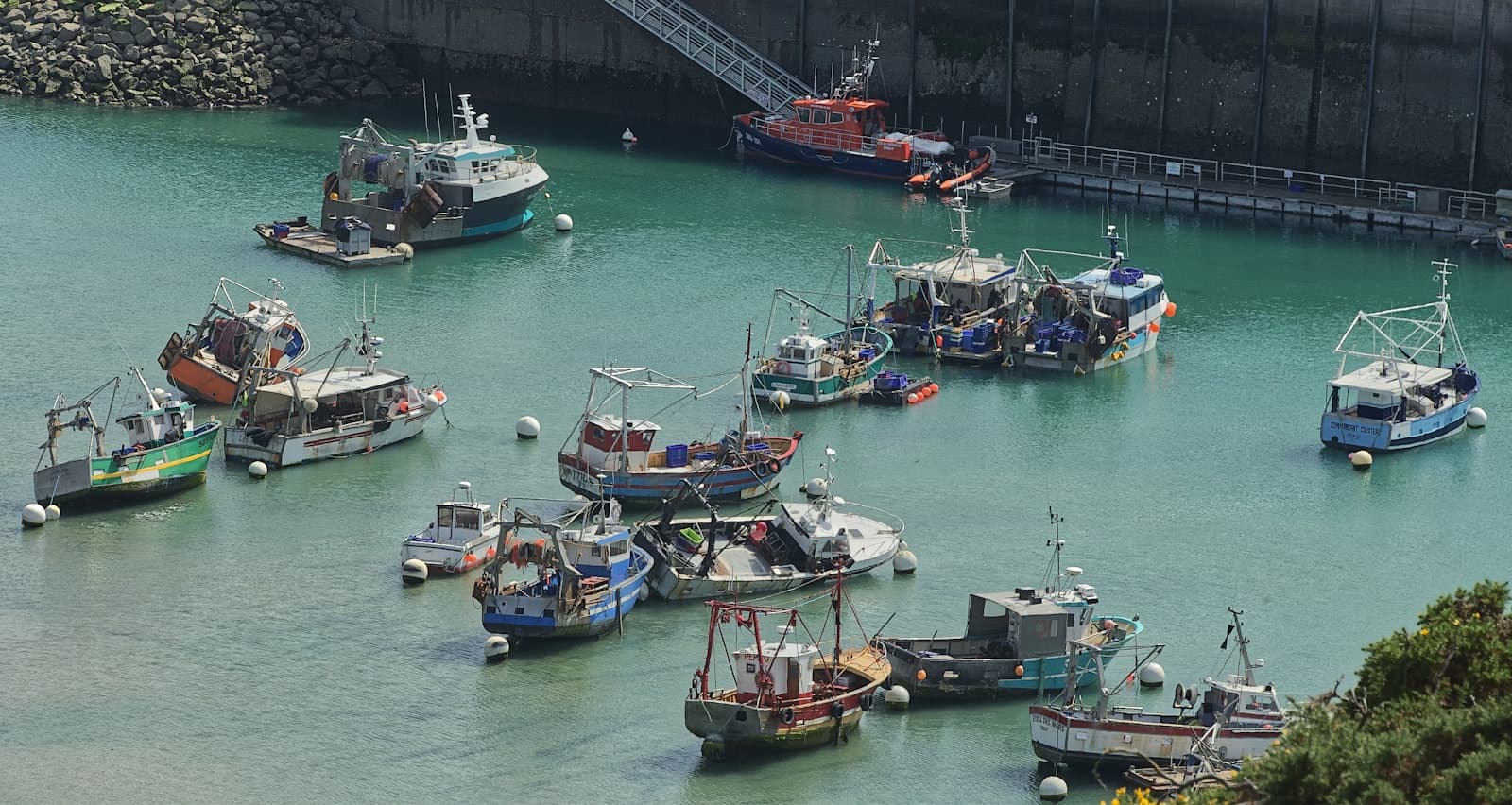
Tide is the periodic rise and fall of the sea under the pull of the Moon and the Sun. On Atlantic coasts, in the Channel and in the North Sea, it governs everything: the depth under your keel, when you can enter harbour, the strength of the streams. Two tools are enough to get started: the spring-neap cycle, which tells you the day's range, and the rule of twelfths, which tells you how fast the water rises or falls.
The mechanics: Moon, Sun and the six-hour cycle
Tides are driven mostly by the Moon's attraction, with the Sun's added on top. On most Atlantic and Channel coasts the regime is semi-diurnal: two high waters and two low waters per lunar day of roughly 24 h 50 — hence times shifting about 50 minutes later each day. The flood (rising tide) lasts around 6 h 10, the ebb (falling tide) about the same. The height difference between high and low water is the range. In the Mediterranean it amounts to a few tens of centimetres and tide is a side topic. In the Atlantic, the Channel and the North Sea, it structures the whole passage plan.
Springs, neaps and how big today's tide is
Spring tides (the biggest ranges) occur when Moon and Sun are aligned, at new and full moon; neap tides (the smallest) when they pull at right angles. Tide tables give you predicted heights for each day; France goes further and grades every tide with a coefficient from 20 to 120, with 95-plus meaning big springs. Concretely, at Saint-Malo the range grows from about 5 metres at neaps to more than 12 metres at the biggest springs, and the Bristol Channel sees some of the largest ranges on Earth. A big range means more water moving in the same time: stronger streams, wider drying areas, extreme heights at both ends. To begin with, pick mid-range tides — mistakes are more forgiving there.
The rule of twelfths, kept simple
The height of tide does not change linearly. Over the six hours of a tide it moves by roughly 1/12 of the range in the first hour, 2/12 in the second, 3/12 in the third and fourth, then 2/12 and 1/12. Example with a 6-metre range: 0.5 - 1 - 1.5 - 1.5 - 1 - 0.5 metres per hour. Two practical consequences: at mid-tide the water moves fastest and streams are usually at their strongest; around high-water and low-water slack, everything quietens down. Always add an under-keel clearance — a safety margin of at least 0.5 to 1 metre depending on the seabed and sea state. One caveat: some areas, such as the Solent with its double high waters, have atypical tidal curves; check the official curves for the port. Terms like slack, range and ebb are covered in the glossary.
Tidal streams: when the sea becomes a river
Flood and ebb generate horizontal streams. In ordinary waters expect 0.5 to 2 knots; in narrows and races it gets serious: the Alderney Race can exceed 9 knots at springs, the Fromveur off Brittany approaches 8, and the Pentland Firth in Scotland is in the same league. For a sailing boat making 5 knots, a 2-knot stream means 40% more or less speed over the ground: you "take the tide", timing your departure to carry a fair stream. The major safety rule: wind against tide raises a short, steep, dangerous sea in the passages. You cross races at slack water or with a fair stream, never in strong wind blowing against the current.
Where tide rules: the Channel, Brittany, the islands
The Channel is a tidal motorway: crossings are planned around alternating streams that reverse every six hours, hour by hour in a tidal stream atlas. North Brittany and the Gulf of Saint-Malo hold Europe's record ranges; the Channel Islands stack fierce races on top. Everywhere in these waters you find rias, bays that dry at low water, and sill marinas accessible only around high water. Further south the Atlantic softens, but estuaries such as the Gironde keep serious streams. In the Mediterranean the astronomical tide is negligible, though barometric pressure still moves the level by a few tens of centimetres.
Where to start: planning a trip in tidal waters
- Get high- and low-water times and the day's range or coefficient (tide tables or an app) for your port and your destination.
- Use the twelfths to work out the height of tide at the critical moments (departure, crossing a sill, return) and add your under-keel clearance.
- Consult a tidal stream atlas and time your departure and headland passages for slack water or a fair stream.
- Cross-check with the weather: wind against tide completely changes the sea state.
- At anchor, size your scope for high water and check the depth left at low water — the full method is in our anchoring guide.
Frequently asked questions
What is the difference between spring and neap tides?
Spring tides occur around new and full moon, when Moon and Sun pull together: the range and the streams are at their biggest. Neap tides occur in between, when the pulls partly cancel: smaller range, gentler streams. Springs are spectacular but demanding; neaps are the forgiving tides to learn on in waters with a big range.
How does the rule of twelfths work?
It describes how fast the water rises or falls over the six hours of a tide: 1/12 of the range in the first hour, 2/12 in the second, 3/12 in the third and fourth, then 2/12 and 1/12. With a 6-metre range, the level moves 1.5 metres per hour at mid-tide, against 0.5 metre at the start and end. It is an approximation, valid for regular tidal curves.
Where are the strongest tidal streams in Europe?
The Alderney Race, between the Cotentin peninsula and Alderney, exceeds 9 knots at big springs — among the most violent streams in Europe, alongside the Pentland Firth in Scotland, the Fromveur off Ushant and the narrows of the Gulf of Morbihan. These passages are taken at slack water or with a fair stream, never against strong opposing wind.
The surest way to know a boat is to sail her.
Before you buy — or simply to get away this season. Tell us your dates and your cruising area, and we source the right boat through our network of owners and vetted fleets.